.jpg)




1909 Spectator Review of Sermon Collection

DR. JOHN BROWN has just published a delightful little book of selections from the writings of Thomas Adams, according to Southey "the Shakespeare of Puritan theologians " ("The Sermons of Thomas Adams," Cambridge University Press, ls. 6d. net).
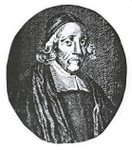
Very little is known of Adams personally; nothing, indeed, save that he was a country parson in the reign of James I. who published sermons, and was the "inward friend" of some of the foremost men of his day, - of William, Earl of Pembroke, and of Sir Thomas Egerton.
Whether or no we agree with Southey (to the mind of the present writer, no man whose didacticism constantly interferes with his sympathy could be called Shakespearean), Thomas Adams's sermons show him to have been a man of genius, and at the same time a man of extraordinarily robust mind; and Dr. Brown has done a service to the public in bringing him once more before their notice.
His disposition was English in a pre-eminent degree. He accepted the Reformed theology, and preached it as the best possible vehicle for the expression of a very real devotion and the only sanction for a common-sense morality.
In secular matters he accepted the status quo as inevitable, if not divinely ordained. He hated rebellion, as he hated oppression. "The common people, like a dead sea," he said, "would be quiet enough" if no man stirred them, "if these blustering winds did not put them in tumult."
The oppressor, however, finds no mercy. Such a one shall "run full butt against the gates of hell and break his neck, and he that at the bars of temporal judgments cried out for nothing but justice, justice, and had it, shall now cry louder for mercy, mercy, and go without it."
He made dogma always the handmaid of morality. He could forgive a dissolute man, but not a hypocrite; a spendthrift, but not a miser. He could see some good in a man of opposite opinions, but none in one of uncertain mind. He regarded abstract speculation as sheer waste of force, the deliberate springing of a leak in the seaworthy ship of conviction.
The great attraction of his sermons lies in their power to express the Englishman's normal way of thinking in the best English of the best period, and to draw satiric portraits of immortal types.
Take first of all the picture of the man who suffers from "the spiritual staggers," - a cruel name, we all feel to-day, for a very sad complaint.
All the same, the contempt expressed by Adams is still the sentiment of the majority:-
"Opinion is his sail : he resolves not to resolve. He knows not what he doth hold. He opens his mind to receive motions, as one opens his palm to take a handful of water - he hath very much, if he could hold it. He is sure to die, but not what religion to die in; he demurs like a posed lawyer, as if delay could remove some impediments. He is drunk when he riseth, and reels in a morning fasting. He knows not whether he should say his Pater noster in Latin
or English, and so leaves it and his prayers unsaid."
Such a man can find no place of rest in a period of transition, whether he live in the time of Elizabeth or Edward VII. "To-day he goes to the quay to be shipped for Rome, but before the tide come, his tide is turned. Even his published utterance pins him to no conclusion. The child of his own brains within a week he is ready to judge a bastard."
Many a man born in England of English parents has, in Adams's eyes, no right to the name, but is a "semi-atheistical cosmopolite."
"He receives many judgments, retains none, embracing so many faiths that he is little better than an infidel. Thus his breast is full of secret combats, contradictions, affirmations, negatives; and, whiles he refuseth to join with others, he is divided in himself."
Our preacher regards the Bible, in theory, as an absolute authority, but when the New Testament puzzles him be has not much hesitation in setting it aside. A stick, he tells us, is a better protection than the Gospel against a dog who is going to bite.
Persecution revolts Adams. At the same time, be has an instinctive dread of "singularity." It is easy to think too much, he is convinced. Because a man is thoughtful he is not to regard every province of thought as his own:-
"There is a generation of men that are too laborious: curious statesmen in foreign commonwealths, busy bishops in others' dioceses, scalding their lips in their neighbour's pottage. This is an ambitious age of meddlers; there are almost as many minds as men, sects as cities, gospels as gossips : as if they laboured the reducing of the old chaos and first informity of things again."
But if Adams has a poor opinion of the men whose convictions are dissolved by much thinking, he has still less of those whose action is hampered by want of courage:-
"He conceives what is good to be done, but fancies difficulties and dangers, like to knots in a bulrush, or rubs in a smooth way. He would bowl well at the mark of integrity, if he durst venture it. He bath no journey to go, but either there are bugs, or he imagines them. Had he a pardon for his brother (being in danger of death,) and a hare should cross him in the way, he would no further, though his brother hanged for it. He owes God some good-will, but he dares not show it. When a poor plaintiff calls him for a witness, he dares not reveal the truth, lest he offend the great adversary."
Worse than all, "he calls his trembling by the name of conscience." With one terrible sentence our author finishes his condemnation. "His religion is primarily his prince's, subordinately his landlord's."
While, however, the preacher reprehends those who fear the great, he has a good deal of belief in race and no quarrel with money. "For us, beloved," he says, we teach you not to cast away the bag, but covetousness." The rich, he assures his audience, have no monopoly of any fault, not even of pride. "Not seldom a russet coat shrouds as high a heart as a silken garment"
Money made by oppression must, he is certain, bring a curse, and a few doles cannot cover the sin. "Perhaps, you think to make amends for all, for you will increase the Stipend of the vicar." God is not deceived because the oppressor bestows a little whiting " upon a church, or "a wainscot seat for his own worship," nor even by his founding "a little almshouse" to "give twelve pence a-piece a-week to six poor people."
"Riches be God's blessings, (not only in themselves, so they are always good, but to us,) when they are gotten honestly, disposed justly, lost patiently. As much happily might be said, secondly, for honour, wherein I will briefly consider how and when it is of God."
In this "second" matter Adams is peculiarly frank. He says what a very great number of persons still think, but what no one dare say in the pulpit to-day. "That is then only true honour where dignity and desert, blood and virtue meet together; the greatness whereof is from blood, the goodness from virtue. Among fools dignity is enough without desert; among wise men desert without dignity. If they must be separated, desert is infinitely better. Greatness without virtue is commended by others' tongues, condemned in thy own heart. Virtue, though without promotion, is More comforted in thy own content than disheartened by others' contempt. It is a happy composition when they are
united."
In all this little book there is not a suggestion of unction. Adams bathes the hypocrite who has "plenty of divinity," but no humanity "to offer to the suffering. Faithfulness and kindness and patriotism he pleads with all his might. Perhaps the most eloquent passage in all his eloquent sermons describes how "the habit of sin takes away the sense of sin." He supposes that in the beginning Conscience says to a man, "Master, look to thyself." "But he stops her mouth with a violent hand. Yet she would fain speak to him, like the importunate widow, to do her justice. He cannot well be rid of her, therefore he sets her a day of hearing, and when it is come faileth her. She cries yet louder for audience ; and when all his corrupt and bribed affections cannot charm her silence, he drowns her complaints at a tavern, or laughs her out of countenance at a theatre. But if the pulse beats not, the body is most dangerously sick; if the conscience prick not, there is a dying soul."
To illustrate his kindness, let any one who is interested in his writings read his exhortation to the masters of apprentices. Not only does he warn the cruel in terms that must, one hopes, have made a few of these child-persecutors tremble, but he counsels the well-meaning but injudicious to avoid "harsh language, uncomfortable checks, and the discouragement of continual snibs."
As to his patriotism, there is a sermon preached before a company of soldiers (Dr. Brown does not quote it) in which the case for "a nation in arms" is put as surely it has never been put since.
What a fine character! - if one may judge of a man by his sermons - convinced, law-abiding, conservative, kindly, and courageous: a true Englishman!
His religion was of a very sincere and very common type. He rested assured that Christ died to save his soul and God lived to preserve his country, that every man knew right from wrong, and if he did not the Scriptures were at hand to explain the difference. As to that higher teaching, those words which were spoken on the Mount of Olives and seemed likely to turn the world upside down, perhaps the man with the "staggers" knew as much about that as he did. Like most of us, he put it aside reverentially as something redounding to the eternal glory of its Author, not to be brought down to the common level of a necessarily faulty practice.