Showing posts with label Biography. Show all posts

2020-03-19

Paxton Hood on Puritan Adams 1

This is from Edwin Paxton Hood Lamps, Pitchers, and Trumpets; lectures ... on the vocation of the preacher. Illustrated by anecdotes, ... of every order of pulpit eloquence, from the great Preachers of all ages 1867
https://www.azquotes.com/author/
25126-Edwin_Paxton_Hood

THOMAS ADAMS has been called the Shakspeare of the Puritans. In no sense does this convey any idea of the place he occupies; but perhaps he was the Herbert - the George Herbert - of the pulpit. There is scarcely a name the age to which he belonged has preserved which is so surrounded by an atmosphere of oblivion as his. He is now to us a voice out of a cloud - at best a shade, and nothing more: “no man knoweth his sepulchre;” there is no likeness of him; nothing is known of his parentage; nothing can be gathered of his life, or his manner of life; over his grave “the iniquity of oblivion,” as Sir Thomas Browne would say, “ has blindly scattered her poppy.” He is, doubtless, found in the register of God; but all about him, if we may trust the industry of those who have sought to perpetuate his works, has passed from the record of man. Our folio edition of his collected works bears the imprint of the year 1629. He was alive in the year 1658, when the two sermons were published included in Dr. Angus’s edition. He can be traced from pulpit to pulpit, but this is all that can be gathered of him.
In 1612 he was preacher of the Gospel at Willington, in Bedfordshire; in 1614 he was at Wingrave, in Buckinghamshire ; in 1618 he held the preachership of St. Gregory’s, under St. Paul’s Cathedral, and was “observant“ chaplain” to Sir Henry Montague, the Lord Chief Justice of England; in 1629 he published the folio collection of his works, now reprinted; in 1633 he published the well-known Commentary on the Second Epistle of Peter; then he vanishes from sight. Hints there are of his being sequestrated during the period of the Revolution and Protectorate - possible, even probable. In 1653 he was living in a “decrepit and necessitous old age,” and most likely died before the period of the Restoration.
Through what an eventful period he lived we have seen; through what changes of events and princes. His sermons have all the marks of the transition age; they have all the mannerisms of the Puritan theology; while in his ideas of government he had all the traces of absolute Toryism. Like most of the Low Church party of the present day, he held no doubt to Puritanism in doctrine, and Whitgiftism in Prelacy, rubric and general Church symbolism. Hence, he not only indulges in ample eulogy upon Queen Elizabeth and her thrice blessed memory, but floats with almost all the preachers and writers of his age in flattering homage to James, and to the doctrine of the divine right of kings. Puritan Adams, no doubt, suffered by being what he must have been, a popular preacher. Had Hooker been under the necessity of delivering his Ecclesiastical Polity in discourses at St. Paul’s Cross, had George Herbert been a city preacher, or Sir Thomas Browne one of the divines of his day, in no instance should we have had the rich, and rare, and peculiar gems they have contributed to our language.
Adams is very popular, but his style is often very rugged. He speaks to the populace, and his fancies and conceits, his anagrams and conundrums of speech, are frequently a snare to him throughout his discourses. He is usually rather pretty than powerful. Instances of bad taste are abundant in his writings; are they not also said to be abundant in the writings of men of his times, far greater than he? Moreover, he was a preacher of an extinct order; for sermons on manners have now gone quite out of date, and his were such. In the pulpit he portrayed character; we cannot say after the manner of Bishop Earle, and Overbury, and Butler, since he preceded these writers. Thus, the portrait of the inconstant and unstable man, like many another such a sketch, justifies this remark :—

He would be a Proteus too, and vary kinds. The reflection of every man’s views melts him; whereof he is as soon glutted. As he is a noun, he is only adjective, depending on every novel persuasion; as a verb he knows only the present tense. To-day he goes to the quay to be shipped for Rome  but before the tides come, his tide is turned. One party thinks him theirs ; the adverse theirs; he is with both—with neither; not an hour with himself. Because the birds and beasts be at controversy, he will be a bat, and get him both wings and teeth. He would come to heaven but for his halting. Two opinions (like two watermen) almost pull him apieces, when he resolves to put his judgment into a boat, and go somewhither: presently he steps back, and goes with neither. It is a wonder if his affections, being but a little lukewarm water, do not make his religion stomach-sick. Indifference is his ballast, and opinion his sail ; he resolves not to resolve. He knows not what he doth hold. He opens his mind to receive notions, as one opens his palm to take a handful of water: he hath very much, if he could hold it. He is sure to die, but not what religion to die in l he demurs like a posed lawyer, as if delay could remove some impediments. He knows not whether he should say his Paternoster in Latin or English; and so leaves it, and his prayers, unsaid. He makes himself ready for an appointed feast; by the way he hears of a sermon; he turns thitherward; and yet, betwixt the church-gate and church-door, he thinks of business and retires home again. He receives many judgments, retains none: embracing so many faiths that he is little better than an infidel. He loathes manna, after two days’ feeding, and is almost weary of the sun for perpetual shining. If the Temple Pavement be ever worn with his visitant feet, he will run far to a new teacher. ... His best dwelling would be his confined chamber, where he would trouble nothing but his pillow. He is full of business at church, a stranger at home, a sceptic abroad, an observer in the street, everywhere a fool. (From The Three Divine Sisters) 

2007-02-02

Beeke and Packer

Thomas Adams (1583-1652)
Thomas Adams graduated from Trinity College, Cambridge ... Northill ... Adams's parishioners signed a petition stating that he had "behaved himself soberly in his conversation, painfully in his calling, lovingly amongst his neighbors, conformable to the orders of the Church, and in all respects befittingly to his vocation" (J. Maltby, Prayer Book and People in Elizabethan and Early Stuart England, p. 78). This testimony may have assisted Adams in securing an appointment the following year as vicar of Willington, Bedfordshire. ... Wingrave ... London ...
Adams was a powerful preacher, much-quoted writer, and influential divine. Prominent leaders in church and state, such as John Donne and the earl of Pembroke, were among his friends.
Adams was a Calvinist Episcopalian in terms of church polity. He was not opposed to kneeling to receive communion and feared that the abolition of episcopacy advocated by some Puritans would lead to Anabaptism. Nonetheless, Adams embraced Puritan theology, polemics, and lifestyle. J. Sears McGee writes, "Like Puritans he craved careful observation of the Sabbath and was deeply hostile to Rome, the Jesuits, and the papacy, as well as to idleness, over-indulgence in worldly pleasures, and conspicuous consumption in all its forms" ...
Adams shared the Puritan concern to purge the Church of England of remaining vestiges of Roman Catholicism or "popery," as it was then called. His open expression of this concern and his identification with the Puritans in many areas, offended William Laud, Archbishop of Canterbury; doubtless, this hindered his preferment in the church. At the same time, Adams was staunchly loyal to the king, and so found himself in disfavor with Cromwell and probably suffered being sequestered under the Commonwealth, left to live out his days dependent on charity in what he called, in the dedication of his posthumously published Anger and Man's Comfort (1653), his "necessitous and decrepit old age."
In 1629, Adams organised his sermons into a massive folio, subsequently printed in three volumes in the Nichol's series reprint of 1861-1866 ... Adams's sermons have been admired since their first printing; they "placed him beyond all comparison in the van of the preachers of England, and had something to do with shaping John Bunyan.... His numerous works display great learning, classical and patristic, and are unique in their abundance of stories, anecdotes, aphorisms, and puns" (Encyclopedia Britannica, 11th ed).
Volume 1 of Adams's works contains his sermons on Old Testament texts, such as "God's Bounty" on Proverbs 3:16, and "Mystical Bedlam" on Ecclesiastes 9:3. Volume 2 contains his sermons on New Testament texts, and volume 3 contains the remaining corpus of New Testament sermons as well as meditations on the Apostles' Creed and a fifty-page memoir of Adams by Josiah Angus.
Adams's sermons are evangelically eloquent and biblically faithful. James I. Packer writes:
His fondness for evangelical allegorizing and verbal pyrotechnics, however, makes his sermons lively rather than weighty. His doctrine is unambiguously Calvinistic, but with a pastoral rather than a speculative or controversial orientation. He does not go deeply into the subject of Christian experience, but is warmly evangelical in extolling the power of Christ, and grace, and faith. The themes on which he is most constant and full, however, are the varieties of sin, the anatomy of hypocrisy, and the stratagems of Satan. Like all the Puritans, he is a thoroughly theocentric thinker, and says much that is illuminating on the ways of God in dealing with sinners in both mercy and judgment. He shows no sympathy with the Puritan program of church reform, but dismisses it as he does all forms of sectarianism and separatism. He is vigorously outspoken against Rome (Encyclopedia of Christianity, ed. Edwin H. Palmer, 1:63)
Not included in Adams's works, is his magnum opus, A Commentary on the Second Epistle General of St. Peter, an extensive commentary first published in 1633 and last reprinted by Soli Deo Gloria in 1990, and happily, reprinted again now by Solid Ground Christian Books. It was never included in any edition of his works. However, the 900 pages of double-columned print was edited by James Sherman and printed in London in 1839. The work is exegetically reliable and stylistically adept. Much useful theological knowledge is conveyed in striking phrases. Spurgeon commented that this book was the best Puritan commentary printed under James Sherman's editorship. It was "full of quaintness, holy wit, bright thought, and deep instruction; we know of no richer and racier reading," Spurgeon said.
This commentary is full of quotable material. For example, on 2 Peter 3:9 ("The Lord is not slack concerning his promise"), Adams writes, "Another cause of the Lord's seeming slackness to deliver us for the present, is our slackness to praise him for deliverances past. Unthankfulness; this is the witch, the sorceress, whose drowsy enchantments have made us even forget God himself. If we forget him, can he be blamed for slackness to remember us?" (p. 688).
Adams is unsurpassed on Second Peter. Though the print is small, the content is rich, and is well worth patient perusal. Here is a feast for ministers and all serious Bible students.
Little is known of the latter part of Adams's career. He appears to have written nothing for print during the last twenty years of his life. He died in 1652. Alexander B. Grosart wrote of him: "Thomas Adams stands in the forefront of our great English preachers. He is not as sustained as Jeremy Taylor, nor so continuously sparkling as Thomas Fuller, but he is surpassingly eloquent and brilliant, and much more thought-laden than either."
Joel R. Beeke, Puritan Reformed Theological Seminary, Grand Rapids, MI

2007-02-01

Aspects of Piety 05

Latter days It is difficult to explain the abrupt disappearance from public view that follows. Much of Adams’ preaching would have been distasteful to Laud, Bishop of London by 1628, and Archbishop of Canterbury from 1633. He increasingly worked to silence any suspected of Puritan leanings. It may be significant that Adams’ friend and patron, metaphysical poet John Donne (1572-1631), died in 1631. Donne had been Dean of St Paul’s since 1621. His removal may have diminished Adams’ standing.
[Donne, ‘England’s greatest love poet’ and leader of the metaphysical school, is also noted for his religious verse, treatises and sermons. Adams dedicated The Barren Tree, preached at Paul’s Cross, 1623, to Donne. Daniel Doerksen (‘Milton and the Jacobean Church of England’, Early Modern Literary Studies 1.1, 1995) helpfully points out how in the 1620s ‘ … there was no great divide between moderate conformists like John Donne and moderate or even fully conforming puritans.’ He notes that Donne was not only Adams’ friend but had been able to ‘satisfy the benchers at Lincoln’s Inn, where his predecessor and successor as reader in divinity were the moderate puritans Thomas Gataker and John Preston.’ He says ‘There is good evidence to show that … Donne … was not essentially a Laudian, but identified strongly with the rather Calvinist Jacobean Church.’]
At the same time, Adams’ staunch defence of the monarchy and ecclesiastical hierarchy must have counted for something. Perhaps it was his strong Calvinism, his view that matters of ceremony were ‘indifferent’, his fierce criticism of the popish ‘idolatry’ that threatened to creep back in and his popularity, that combined to bring about his disappearance from public view.
For evidence of Adams' Calvinism see Angus, Works 3, pp xxvii, xxviii. In a piece of unwarranted hyperbole, Angus says ‘Adams is as fair a representative of Calvinistic doctrine as Calvin himself.’!
Thinking on the Jacobean church has altered greatly since the 19th Century. It is no longer acceptable to posit the idea that Anglicans and Puritans were distinct and coherent groups, with no middle ground. It is incorrect to suppose that there were no moderate or non-separatist Puritans or that only Puritans were Calvinists and interested in doctrine and preaching. Doerksen says that Milton’s high esteem for Calvin was probably shared by most leaders of the Jacobean church. Anti-popish sentiments abound in Adams. To complaints of excess he answers ‘I can often pass his door and not call in; but if he meets me full in the face and affronts me, for good manners’ sake, … I must change a word with him.’ (Works 1, p 203).
Ironically, he had few friends on the Puritan side and their rise to power in the 1640s would not have helped him either. Phrases such as this could have been seized upon ‘The unicorn – that is, the hypocrite – the foul-breasted, fair-crested, factious Puritan hath but one horn; but therewith he doth no small mischief,’ ‘And there be bawling curs, rural ignorants; that blaspheme all godliness under the name of Puritanism.’ (Works 2, pp 118, 119). He was denounced in a 1647 Puritan tract as ‘a known profane pot-companion, ... and otherwise a loose liver, a temporising ceremony monger, and malignant against the parliament.’ (Cf Baker, Dictionary of Literary Biography)
His loyalty to the king, tolerance of ceremony and support for episcopalian church government would have made him objectionable to many. Unable to escape the political vicissitudes of his times, Adams, may well have been sequestered as were many clergy unsympathetic to the Parliamentarian cause. (Cf Angus, relying on Newcourt’s Repertorium, Works 3, pp ix, xiii). Angus is sceptical and suggests that other factors may have brought the living to an end. By 1642 he was probably no longer Rector of St Benet’s, though probably remaining in the rectory.
Stowell and Angus helpfully speak of Adams as a ‘Doctrinal Puritan’ in order to emphasise that although he was Calvinistic, Anti-papist and a preacher of the Word, he did not make a stand on issues of rites, forms and ceremonies from the church’s Roman past. ( Cf Angus, Works 3, p xiii; Stowell, p xiv). Adams prized unity and often railed against the schismatic tendencies of some in the Puritan party. (He speaks of Anglican efforts to deal with Roman ceremonies by reducing them ‘for their number to paucity, for their nature to purity, for their use to significancy’. ‘Separate we not then from the church’ he says ‘because the church cannot separate from all imperfection’. Works 2, p 156.)

2007-01-30

Aspects of Piety 04

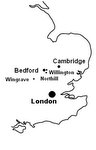
In 1614, Adams accepted an appointment as Vicar of Wingrave, Buckinghamshire, residing there until 1618. (See here). Like his previous calling it was facilitated by Thomas Egerton, Baron Ellesmere. Buckinghamshire and Bedfordshire are adjacnet and Adams’ early years of ministry were all spent in the same vicinity. (See map). While at Wingrave, he seems to have taken up a lectureship at St Gregory’s in London, a church dating from the 7th Century near to the old St Paul’s Cathedral. It was destroyed in the Great Fire of 1666. (The site is now occupied by the clock tower of St Paul’s according to Angus, Works 3, p xi).
Lectureships, especially popular in London, were a Puritan attempt to promote preaching. ‘These lecturers (almost entirely called and supported the laity) created a situation in which much of the preaching in the city took place outside of normal ecclesiastical lines of authority’ (Mark Dever, Richard Sibbes Puritanism and Calvinism in late Elizabethan and early Stuart England, p 81). A full study can be found in Seaver.
The ODNB also mentions a chaplaincy at this time to Sir Henry Montague, later Earl of Manchester, the Lord Chief Justice or Privy-seal. Adams dedicated his works of 1629 to Montague and to William, Earl of Pembroke, Lord Chamberlain and privy counsellor, founder of Pembroke College, Oxford. Immediate successors of both served in the Westminster Assembly. His 1633 work on 2 Peter was dedicated to the eminent civil lawyer and judge Sir Henry Marten.
During the Wingrave years, Adams published several collections of sermons and was in demand as a popular city preacher. He retained his lectureship at St Gregory’s until at least 1623, but as, following the Synod of Dort, King James became increasingly pro-Arminian and discouraged lectureships (even before Laud began outlawing them), this probably came to an end.
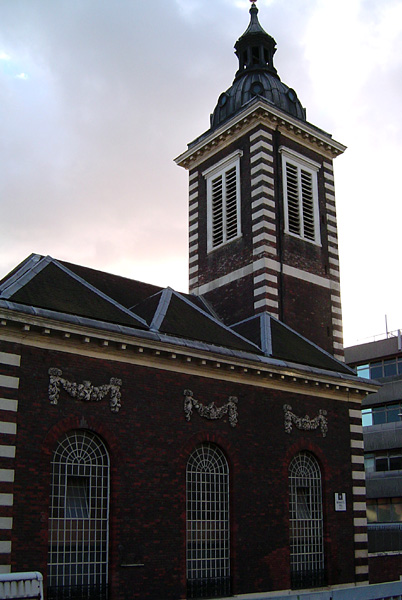
By 1619 Adams was rector of nearby St Benet’s, Paul’s Wharf. (The church was replaced after the Great Fire by a red brick Wren church, now home to London Welsh episcopalians. See here.) He resided there it seems until his death, dependent on fluctuating funds available to St Paul’s. In December 1623 his wife died. There is no evidence that he remarried.
Still much in demand, he preached his final sermons at Paul’s Cross in 1623 and 1624. The Temple commemorated King James’s preservation from the gunpowder plot. Three Sermons, 1625, suggests continued prominence as it includes sermons for the Lord Mayor’s election, the triennial visitation of the Bishop of London and mourners at Whitehall two days after King James’s death.

2007-01-29

Aspects of Piety 03

Preaching
It is difficult at this remove to appreciate how popular preaching and printed sermons were in the 17th Century. The reading public was far greater than historians once thought and there was a flood of literature of all sorts to sate its appetite. This flood inevitably spilled over and affected more illiterate sections of the population too. Alexandra Walsham (Providence in early modern England p 33) has written of
an explosion of cheaply priced printed texts designed to entertain, edify, and satisfy the thirst of a rapidly expanding reading public for information. … Hawked and chanted at the doors of theatres, alehouses, and other habitual meeting spots, and displayed for sale in shops in the vicinity of St Paul’s churchyard, they also penetrated the provinces and countryside to a degree which is only gradually coming to light.
The nation’s preachers seem initially simply to have bewailed this flood of largely unhelpful literature. Then, reluctantly at first, they began to swell it with the most wholesome material they could produce in various formats, from cheap unbound booklets to high quality folio editions. An incentive to putting sermons into print was the fact that unscrupulous printers might otherwise produce pirated and potentially inaccurate editions, so great was the demand for such material. While sermons undoubtedly held little attraction for some, there was a sizable number for whom ‘they were like an addictive and intoxicating drug’. (Walsham p 61)
Perhaps especially in London preaching was as much a communal gathering as a solemn spiritual event, to which restive and wayward youth eagerly swarmed.
In general, both hearers of preaching and readers of sermons were many and varied. (Walsham, p 62). Adams complains of ‘perfunctory hearing’, (Works 2, p 271) and asks ‘How many sermons are lost whiles you bring not with you the vials of attention.’ ‘You come frequently to the wells of life,’ he complains ‘but you bring no pitchers with you.’ The people either lack mouths to receive the balm of grace or bottoms to retain it. (Works 3, p 366) He also says '… never did the Egyptians call so fast upon the Israelites for making of bricks, as the people call on us for the making of sermons; (Cf Works 2, p 169). Typically, he cannot resist adding ‘and our allowance of materials is much alike’! He asks of London ‘What city in the world is so rich in her spiritual provision as this? Some whole countries within the Christian pale have not so many learned and painful pastors as be within these walls and liberties.’ (Works 2, p 271) Paul Seaver has commented ‘In its preaching, as in so many other respects, London was without rival. Nowhere else were there so many lectureships packed into so small an area ….’ (The Puritan lectureships the politics of religious dissent 1560-1662 p 121)
Adams was one of many who sought to capitalise on this interest through printed sermons. Various means were used to reduce sermons to print. We do not know what happened in Adams’ case but judging from the presentation of the material and its general lack of literary (as opposed to homiletical) polish, it would seem that amanuenses were employed to record Adams’ sermons verbatim. (Cf ‘I know you have long looked for an end; I never delighted in prolixity.’
‘I know you have long looked for an end; I never delighted in prolixity.’ Works 1, , p 421; ‘… it hath led me further than either my purpose or your patience would willingly have allowed me.’ Works 2, p 38; ‘You see the measure [the hour glass]. Only give me leave to set you down two short rules …’ Works 2, p 45; ‘I am loath to give you a bitter farewell, or to conclude with a menace. I see I cannot, by the time’s leave, drink to you any deeper in this cup of charity .…’ Works 2, p 412.)
His sermons vary in length. Possibly material was added. Sensitive to accusations of simply affecting to be a man in print, in 1630 he rehearses a popular argument for printing sermons in his dedication ‘to the candid and ingenious reader’.
Speech is only for presence, writings have their use in absence … our books may come to be seen where ourselves shall never be heard. These may preach when the author cannot, and (which is more) when he is not.
(Works 3, p ix). It had been profitable when he spoke it and now he hopes it will be profitable in written form (Cf Works 3, p xvii).

2007-01-28

Aspects of Piety 02

As for the man himself, scant detail regarding his life outside the pulpit exists. Moira Baker says ‘ … the eclipse of his reputation belies the achievement of his earlier career and his enduring stature as a gifted preacher.’ ‘The man we cannot see,’ wrote Joseph Angus in 1866 ‘nor have we found a witness that has seen him’. Or as W H Stowell put it 20 years before, ‘His only monument is in his works. (See here.)
Our ignorance is so great that we know neither where or when he was born, nor when he died. The ODNB guesses 1583-1652.
It was uncertain at one time whether he was a university man but evidence has apparently surfaced to say that he went to Trinity College, Cambridge, in 1598 from where he graduated BA in 1601 (see here) and gained an MA in from Clare College (then Clare Hall) in 1606 (see here). This fits with his remark about universities being ‘nurseries of Christian learning’ (Works 2, p 112. Also note ‘For only about 5 per cent (38) of the [London] lecturers is there good reason to suppose that they did not attend university at all.’ Paul Seaver, The Puritan lectureships the politics of religious dissent 1560-1662, Stanford, California, Stanford UP, 1970, p 181).
We also know that at some point he married and had a son and two daughters, the latter predeceasing him in 1642 and 1647. Probably he was born in the early 1580s, in the reign of Elizabeth I. (It is clear from his occasional references to her that Adams respected good Queen Bess and King James too). As for his death, we know that in 1652 he was in ‘necessitous and decrepit old age’. (Cf Works 3, pp lvi and 264). It would seem that he ‘relied upon the charity of his former parishioners during the final months of his life’ which presumably came while in his seventies, before the Restoration of 1660.
A further known date is his ordination in the Diocese of Lincoln in 1604, the year after James came to the throne. The following year Adams was licensed to the curacy of Northill, Bedfordshire, but was soon dismissed when Northill College Manor was sold. (See here). By 1611 it seems he was vicar in the village of Willington, near Bedford, where he remained until 1614, pursuing a ministry of preaching and putting sermons into print. (See here). While at Willington, he preached at least once before the Bedford clergy at an Archdeacon’s visitation and twice from Paul’s Cross. These sermons were published, as was the common practice at the time. So even as a young man his sermons were being published

2007-01-27

Map

Paul's Wharf

http://en.wikipedia.org/wiki/User:ChrisO
St Benet, Paul's Wharf, (St Benet Woodwharf) was the main place where Adams served when in London. The building seen here is post-1666 and the great fire and built by Wren (1677-83). It is situated where Upper Thames St/White Lion Hill/Queen Victoria St EC4 meet. First mentioned in the 12th century. The church has been used by a Welsh congregation since 1879. Parish united with St Nicholas Cole Abbey 1879.

Wingrave


St Peter and St Paul, Wingrave, Buckinghamshire, where Adams served from the very end of 1614 until some time in 1619

Willington


St Laurence , Willington, Bedfordshire, where Adams served 1612-1614

and the nearby

stables and

dovecote there,

built in 1541.

Northill


St Mary's, Northill, Bedfordshire, where Adams served as curate, 1605-1611

Aspects of Piety 01

Introduction
During recent studies in the Puritans I produced an essay on Adams and his piety. It appeared in the journal Foundations in modified form. This is how it began:

But when the gospel came to us in Queen Elizabeth’s days, of so blessed memory, we also had much peace. We had with Gloria in ex celsis Deo, sung also Pax in terris. The iron gates of war were shut up, and the long tossed ark of our church had an olive-branch of flourishing peace bestowed upon it. The fury of an adversary was not known, but ‘righteousness and peace kissed each other.’ Yet was not this peace without great fires:
1. There was a great fire of Anabaptism: a gross, perverse, and sottish sect, that had washed off their font-water as unclean, and thought it not enough to run out of Babylon, unless they ran also out of themselves, out of their wits. …
2. There was a great fire of Brownism: an ignis fatuus, fastening on abundance of crude and squalid matter, that could not easily be extinguished. It was blown up with the bellows of pride; and because it might not have its own swing, it fell to direct railing. They say the church of England may be their mother, but is none of God’s wife. Why do they not call her plain ‘whore?’ for such is a mother that hath children, and no husband. But these the whiles are brave sons, who care not to prove themselves bastards, that their mother may be noted for a harlot. But the shame be their own, integrity hers; who hath not defiled her bed, though they have shamed her womb. …
3. There was a raging fire of the Papists; who to maintain their spiritual fire of superstition, made use of material fire to set a whole land in combustion. How unspeakable were their treasons against that gracious princess! which yet if we gather up into one volume, we shall find their last equalling all: which should have been a fire, a fire indeed, such a one as hell itself could only belch out. But bless we our God, that with sweet showers of mercy rained it out.
These fires have been kindled in a land of peace, though many tears have been showered upon them, and earnest prayers sent up to heaven for their quenching. Yea, and will be still, so long as that crown-shorn generation can transport their burning quills into England; and their great Antichrist, the successor not of Peter, but of Romulus, sits on that fiery chair. …

{See Works of Thomas Adams 2, p 152}
These words were preached in 1623 at ‘the open air pulpit in the church yard of St Paul’s Cathedral’ known as Paul’s Cross. (For a note on Paul's cross see here). They were preached by one Thomas Adams, a man ranked above ‘silver-tongued’ Henry Smith by John Brown (See preface to his 1909 collection of sermons here. Smith, 1560-1591, was a popular Puritan lecturer at St Clement Danes, London; short lived, his works remain in print) and who has been described as ‘one of the most gifted preachers’ of his day (W K Jordan, The development of religious toleration in England 1603-1640, Cambridge, Massachusetts, Harvard UP, 1936, p 155) and the ‘greatest of all early Puritan divines’ (W Fraser Mitchell, English Pulpit Oratory from Andrewes to Tillotson: A Study of its Literary Aspects, New York, Russell and Russell, 1932 [reprint 1962]; quoted by Baker).
With well over a million words in print, (besides the sermons in the collected Works there is a massive Commentary on the Second Epistle General of Peter) he is a bright star in a veritable galaxy of 17th Century divines whose reputation today rests chiefly in their literary output. In his own day, Adams was often quoted in commonplace books. (Works 3, p x. Referring to the Library of William Bentley, preserved in Alleghenny College, Edwin Wolf says interestingly ‘He did own, as did most colonial Americans who had a shelf of folios, Foxe’s Book of Martyrs, the works of Thomas Adams, … the sermons of Lancelot Andrewes’. See here.) Today he is largely forgotten but his works are still available and are still quoted. In the book by I D E Thomas, A Puritan Golden Treasury (Edinburgh, Banner of Truth Trust, 1977) of 145 Puritans quoted, Adams is cited more than most. Only the later eminently quotable William Gurnall (1617-1679) and Thomas Watson (c1620-1686) appear to have provided more material.

Literary Biography


A literary essay on Thomas Adams
can be found here
It is the appropriate entry from the
Dictionary of Literary Biography: British Prose Writers of the Early Seventeenth Century
It is by Dr Moira Baker

ODNB Entry

This is the entry for our Thomas Adams in the Oxford Dictionary of National Biography. The author is J Sears McGee.
Adams, Thomas (1583–1652), Church of England clergyman, matriculated from Trinity College, Cambridge, in the Lent term of 1598 and graduated BA in 1602 and proceeded MA in 1606 from Clare College; he was ordained deacon and priest in Lincoln diocese on 23 September 1604. He served as curate of Northill, Bedfordshire, from 1605 to 1611, when he was sacked by its new patron. However, his Northill parishioners signed a petition stating that Adams had ‘behaved himselfe soberly in his conversation, painfully in his calling, lovingly amongst his neighbours, conformable to the orders of the Church, and in all respects befittingly to his vocation’ (Maltby, 78), and this testimony may have aided his appointment in 1612 as vicar of Willington, Bedfordshire, by its patron, Thomas Egerton, Baron Ellesmere.
Ellesmere advanced him on 21 December 1614 to the vicarage of Wingrave, Buckinghamshire, but by 1619 Adams was in London, where he remained for the rest of his life. The dean and chapter of St Paul's in 1619 collated him to two rectories, St Benet Paul's Wharf (on 15 June) and the small church of St Benet Sherehog (on 6 July). From 1618 to 1623 he also preached at St Gregory by Paul's. He served as chaplain to Henry Montagu, first earl of Manchester and chief justice of king's bench, and the dedicatees of his numerous published sermons included such influential men as Ellesmere, Montagu, Donne and William Herbert, third earl of Pembroke. Pembroke and Manchester also received the dedication of Adams's Works (1629), and his extensive Commentary (1633) on the second epistle of Peter was dedicated to the eminent civil lawyer and judge Sir Henry Marten.
Adams ‘was esteemed an Excellent Preacher’ by his contemporaries (Walker, 2.164), and a modern assessment holds that he is ‘one of the more considerable buried literary talents of the seventeenth century’ (Chandos, 156). Sermon titles such as Mystical Bedlam (1615), The White Devil (1614), The Devil's Banquet (1614), and The Gallant's Burden (1612) exemplify his lively style. Although Adams was described by Robert Southey as ‘the prose Shakespeare of puritan theologians … scarcely inferior to Fuller in wit or to Taylor in fancy’ (DNB), he was a Calvinist episcopalian rather than a puritan. Like puritans he craved careful observation of the sabbath and was deeply hostile to Rome, the Jesuits, and the papacy, as well as to idleness, over-indulgence in worldly pleasures, and conspicuous consumption in all its forms. His sermons abound in statements that puritans would have admired. For example, at Paul's Cross in 1623 he thundered against London's:

innumerable swarmes of … men and women, whose whole imployment is, to goe from their beds to the Tap-house, then to the Play-house, where they make a match for the Brothel-house, and from thence to bed againe … What an armie of these might bee mustred out of our Suburbs? (The Barren Tree, 1623, 48–9

When James I sought a Spanish marriage for Prince Charles, Adams denounced ‘the Romish Idols’ and Solomon's disastrous love of ‘idolatrous women’; he concluded that ‘when Religion and Superstition meet in one bed, they commonly produce a mungrell generation’ (The Temple, 1624, 34–5). Unlike puritans, however, he endorsed kneeling to receive communion and castigated the ‘fond scrupulositie’ of those who demanded such a rigid ‘conformitie to the primitive times, as if the Spouse of Christ might not weare a lace or a border, for which she could not plead prescription’. For Adams the outcome of the abolition of episcopacy that some puritans sought would have been a nightmarish ‘Anabaptisticall ataxie or confusion’ (Works, 931, 933).
From the 1610s through the mid-1620s Adams was highly visible in print, but for reasons which are unclear he spent the latter part of his career in obscurity, publishing nothing after 1633. Although two of Adams's powerful patrons, Pembroke and Ellesmere, were gone from the scene before 1630 Manchester remained a potent figure in the 1630s, but the connection yielded no obvious further advantage. Adams held the rectory of St Benet Paul's Wharf until sequestered during the civil wars, but thereafter continued to live in the rectory house. In a posthumously published work, God's Anger and Man's Comfort (1653), he referred to his ‘neccessitous and decrepit old age’. In his will, dated 12 April 1651, he stated his desire to be buried in the churchyard with few friends attending and ‘without any Funerall Service’ (Walker rev., 42). The small bequests to several grandchildren (the highest 10 shillings) are the only evidence that he had married; the fact that the grandchildren had two other surnames indicate that he had at least two daughters. He died in 1652, and was buried on 26 November.

Disambiguation


Wikipedia and the Oxford Dictionary of National Biography reveal that Thomas Adams was the name of the 12 following men:

Thomas Adams (playwright) (1580-1653) English playwright
Sir Thomas Adams, 1st Baronet (1586-1668) Lord Mayor of London
Thomas Adams (publisher) (c1566-1620) English bookseller, etc
Thomas Adams (writer) (1631/2-1670) ejected minister, religious writer
Thomas Adams (1730?–1764) army officer
Thomas Adam[s] (1701–1784) Church of England clergyman
Thomas Adams (politician) (1730-1788) Virginia delegate, Continental Congress
Thomas Adams (musician) (1785-1858) English organist, composer
Thomas Adams (1807–1873) lace merchant, manufacturer
Thomas Adams (architect) (1871-1940) pioneer of urban planning
Thomas Sewall Adams (1873-1933) American economist, educator
Thomas Adams (professor) (1966-) Professor Rose-Hulman Insititue of Technology
Our subject is none of these but rather concerns
Thomas Adams (c1583–1652) Church of England clergyman

Britannica 1911

ADAMS, THOMAS (d. c. 1655), English divine, was, in 1612, "a preacher of the gospel at Willington," in Bedfordshire, where he is found until 1614, and whence issued his Heaven and Earth Reconciled, The Devil's Banquet and other works. In 1614-1615 he was at Wingrave, in Buckinghamshire, probably as vicar, and published a number of works in quick succession; in 1618 he held the preachership at St Gregory's, under St Paul's Cathedral, and was "observant chaplain" to Sir Henry Montague, the lord chief justice of England. These bare facts we gather from epistles-dedicatory and epistles to the reader, and title-pages. These epistles show him to have been on the most friendly terms with some of the foremost men in state and church, though his ardent protestantism offended Laud and hindered his preferment. His "occasionally" printed sermons, when collected in 1629, placed him beyond all comparison in the van of the preachers of England, and had something to do with shaping John Bunyan. He equals Jeremy Taylor in brilliance of fancies and Thomas Fuller in wit. Robert Southey calls him "the prose Shakespeare of Puritan theologians." His numerous works display great learning, classical and patristic, and are unique in their abundance of stories, anecdotes, aphorisms and puns. His works were edited in J P Nichol's Puritan Divines by J Angus and T Smith (3 vols 8vo, 1862)