2007-01-30

Clare College

Formerly Clare Hall. This was where Adams studied for his MA.

Trinity College


Trinity College, Cambridge, where Adams studied as an undergraduate

Aspects of Piety 04

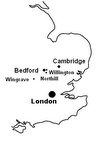
In 1614, Adams accepted an appointment as Vicar of Wingrave, Buckinghamshire, residing there until 1618. (See here). Like his previous calling it was facilitated by Thomas Egerton, Baron Ellesmere. Buckinghamshire and Bedfordshire are adjacnet and Adams’ early years of ministry were all spent in the same vicinity. (See map). While at Wingrave, he seems to have taken up a lectureship at St Gregory’s in London, a church dating from the 7th Century near to the old St Paul’s Cathedral. It was destroyed in the Great Fire of 1666. (The site is now occupied by the clock tower of St Paul’s according to Angus, Works 3, p xi).
Lectureships, especially popular in London, were a Puritan attempt to promote preaching. ‘These lecturers (almost entirely called and supported the laity) created a situation in which much of the preaching in the city took place outside of normal ecclesiastical lines of authority’ (Mark Dever, Richard Sibbes Puritanism and Calvinism in late Elizabethan and early Stuart England, p 81). A full study can be found in Seaver.
The ODNB also mentions a chaplaincy at this time to Sir Henry Montague, later Earl of Manchester, the Lord Chief Justice or Privy-seal. Adams dedicated his works of 1629 to Montague and to William, Earl of Pembroke, Lord Chamberlain and privy counsellor, founder of Pembroke College, Oxford. Immediate successors of both served in the Westminster Assembly. His 1633 work on 2 Peter was dedicated to the eminent civil lawyer and judge Sir Henry Marten.
During the Wingrave years, Adams published several collections of sermons and was in demand as a popular city preacher. He retained his lectureship at St Gregory’s until at least 1623, but as, following the Synod of Dort, King James became increasingly pro-Arminian and discouraged lectureships (even before Laud began outlawing them), this probably came to an end.
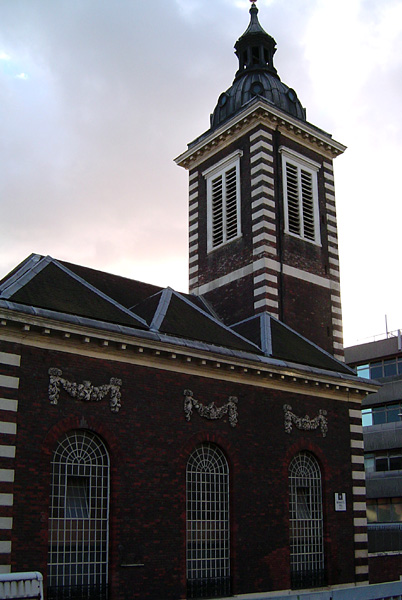
By 1619 Adams was rector of nearby St Benet’s, Paul’s Wharf. (The church was replaced after the Great Fire by a red brick Wren church, now home to London Welsh episcopalians. See here.) He resided there it seems until his death, dependent on fluctuating funds available to St Paul’s. In December 1623 his wife died. There is no evidence that he remarried.
Still much in demand, he preached his final sermons at Paul’s Cross in 1623 and 1624. The Temple commemorated King James’s preservation from the gunpowder plot. Three Sermons, 1625, suggests continued prominence as it includes sermons for the Lord Mayor’s election, the triennial visitation of the Bishop of London and mourners at Whitehall two days after King James’s death.

2007-01-29

Aspects of Piety 03

Preaching
It is difficult at this remove to appreciate how popular preaching and printed sermons were in the 17th Century. The reading public was far greater than historians once thought and there was a flood of literature of all sorts to sate its appetite. This flood inevitably spilled over and affected more illiterate sections of the population too. Alexandra Walsham (Providence in early modern England p 33) has written of
an explosion of cheaply priced printed texts designed to entertain, edify, and satisfy the thirst of a rapidly expanding reading public for information. … Hawked and chanted at the doors of theatres, alehouses, and other habitual meeting spots, and displayed for sale in shops in the vicinity of St Paul’s churchyard, they also penetrated the provinces and countryside to a degree which is only gradually coming to light.
The nation’s preachers seem initially simply to have bewailed this flood of largely unhelpful literature. Then, reluctantly at first, they began to swell it with the most wholesome material they could produce in various formats, from cheap unbound booklets to high quality folio editions. An incentive to putting sermons into print was the fact that unscrupulous printers might otherwise produce pirated and potentially inaccurate editions, so great was the demand for such material. While sermons undoubtedly held little attraction for some, there was a sizable number for whom ‘they were like an addictive and intoxicating drug’. (Walsham p 61)
Perhaps especially in London preaching was as much a communal gathering as a solemn spiritual event, to which restive and wayward youth eagerly swarmed.
In general, both hearers of preaching and readers of sermons were many and varied. (Walsham, p 62). Adams complains of ‘perfunctory hearing’, (Works 2, p 271) and asks ‘How many sermons are lost whiles you bring not with you the vials of attention.’ ‘You come frequently to the wells of life,’ he complains ‘but you bring no pitchers with you.’ The people either lack mouths to receive the balm of grace or bottoms to retain it. (Works 3, p 366) He also says '… never did the Egyptians call so fast upon the Israelites for making of bricks, as the people call on us for the making of sermons; (Cf Works 2, p 169). Typically, he cannot resist adding ‘and our allowance of materials is much alike’! He asks of London ‘What city in the world is so rich in her spiritual provision as this? Some whole countries within the Christian pale have not so many learned and painful pastors as be within these walls and liberties.’ (Works 2, p 271) Paul Seaver has commented ‘In its preaching, as in so many other respects, London was without rival. Nowhere else were there so many lectureships packed into so small an area ….’ (The Puritan lectureships the politics of religious dissent 1560-1662 p 121)
Adams was one of many who sought to capitalise on this interest through printed sermons. Various means were used to reduce sermons to print. We do not know what happened in Adams’ case but judging from the presentation of the material and its general lack of literary (as opposed to homiletical) polish, it would seem that amanuenses were employed to record Adams’ sermons verbatim. (Cf ‘I know you have long looked for an end; I never delighted in prolixity.’
‘I know you have long looked for an end; I never delighted in prolixity.’ Works 1, , p 421; ‘… it hath led me further than either my purpose or your patience would willingly have allowed me.’ Works 2, p 38; ‘You see the measure [the hour glass]. Only give me leave to set you down two short rules …’ Works 2, p 45; ‘I am loath to give you a bitter farewell, or to conclude with a menace. I see I cannot, by the time’s leave, drink to you any deeper in this cup of charity .…’ Works 2, p 412.)
His sermons vary in length. Possibly material was added. Sensitive to accusations of simply affecting to be a man in print, in 1630 he rehearses a popular argument for printing sermons in his dedication ‘to the candid and ingenious reader’.
Speech is only for presence, writings have their use in absence … our books may come to be seen where ourselves shall never be heard. These may preach when the author cannot, and (which is more) when he is not.
(Works 3, p ix). It had been profitable when he spoke it and now he hopes it will be profitable in written form (Cf Works 3, p xvii).

2007-01-28

Aspects of Piety 02

As for the man himself, scant detail regarding his life outside the pulpit exists. Moira Baker says ‘ … the eclipse of his reputation belies the achievement of his earlier career and his enduring stature as a gifted preacher.’ ‘The man we cannot see,’ wrote Joseph Angus in 1866 ‘nor have we found a witness that has seen him’. Or as W H Stowell put it 20 years before, ‘His only monument is in his works. (See here.)
Our ignorance is so great that we know neither where or when he was born, nor when he died. The ODNB guesses 1583-1652.
It was uncertain at one time whether he was a university man but evidence has apparently surfaced to say that he went to Trinity College, Cambridge, in 1598 from where he graduated BA in 1601 (see here) and gained an MA in from Clare College (then Clare Hall) in 1606 (see here). This fits with his remark about universities being ‘nurseries of Christian learning’ (Works 2, p 112. Also note ‘For only about 5 per cent (38) of the [London] lecturers is there good reason to suppose that they did not attend university at all.’ Paul Seaver, The Puritan lectureships the politics of religious dissent 1560-1662, Stanford, California, Stanford UP, 1970, p 181).
We also know that at some point he married and had a son and two daughters, the latter predeceasing him in 1642 and 1647. Probably he was born in the early 1580s, in the reign of Elizabeth I. (It is clear from his occasional references to her that Adams respected good Queen Bess and King James too). As for his death, we know that in 1652 he was in ‘necessitous and decrepit old age’. (Cf Works 3, pp lvi and 264). It would seem that he ‘relied upon the charity of his former parishioners during the final months of his life’ which presumably came while in his seventies, before the Restoration of 1660.
A further known date is his ordination in the Diocese of Lincoln in 1604, the year after James came to the throne. The following year Adams was licensed to the curacy of Northill, Bedfordshire, but was soon dismissed when Northill College Manor was sold. (See here). By 1611 it seems he was vicar in the village of Willington, near Bedford, where he remained until 1614, pursuing a ministry of preaching and putting sermons into print. (See here). While at Willington, he preached at least once before the Bedford clergy at an Archdeacon’s visitation and twice from Paul’s Cross. These sermons were published, as was the common practice at the time. So even as a young man his sermons were being published

2007-01-27

Map

Paul's Wharf

http://en.wikipedia.org/wiki/User:ChrisO
St Benet, Paul's Wharf, (St Benet Woodwharf) was the main place where Adams served when in London. The building seen here is post-1666 and the great fire and built by Wren (1677-83). It is situated where Upper Thames St/White Lion Hill/Queen Victoria St EC4 meet. First mentioned in the 12th century. The church has been used by a Welsh congregation since 1879. Parish united with St Nicholas Cole Abbey 1879.